Most "AI stock analysis" you've seen is the same product wearing different logos: one large language model, one prompt, one opinion. When that opinion happens to align with consensus, it feels useful. When it disagrees, you have no way to tell whether it's catching something real or just hallucinating.
We built something different. The Occam's Forensic Jury runs every public company through four independent AI models — each with a different forensic mandate, each operating on the same source data, each producing its own verdict before the others see it. Then we merge by weighted-mean, with one override: any single FLAGGED verdict forces the entire jury to FLAGGED. Dissent is amplified, not suppressed.
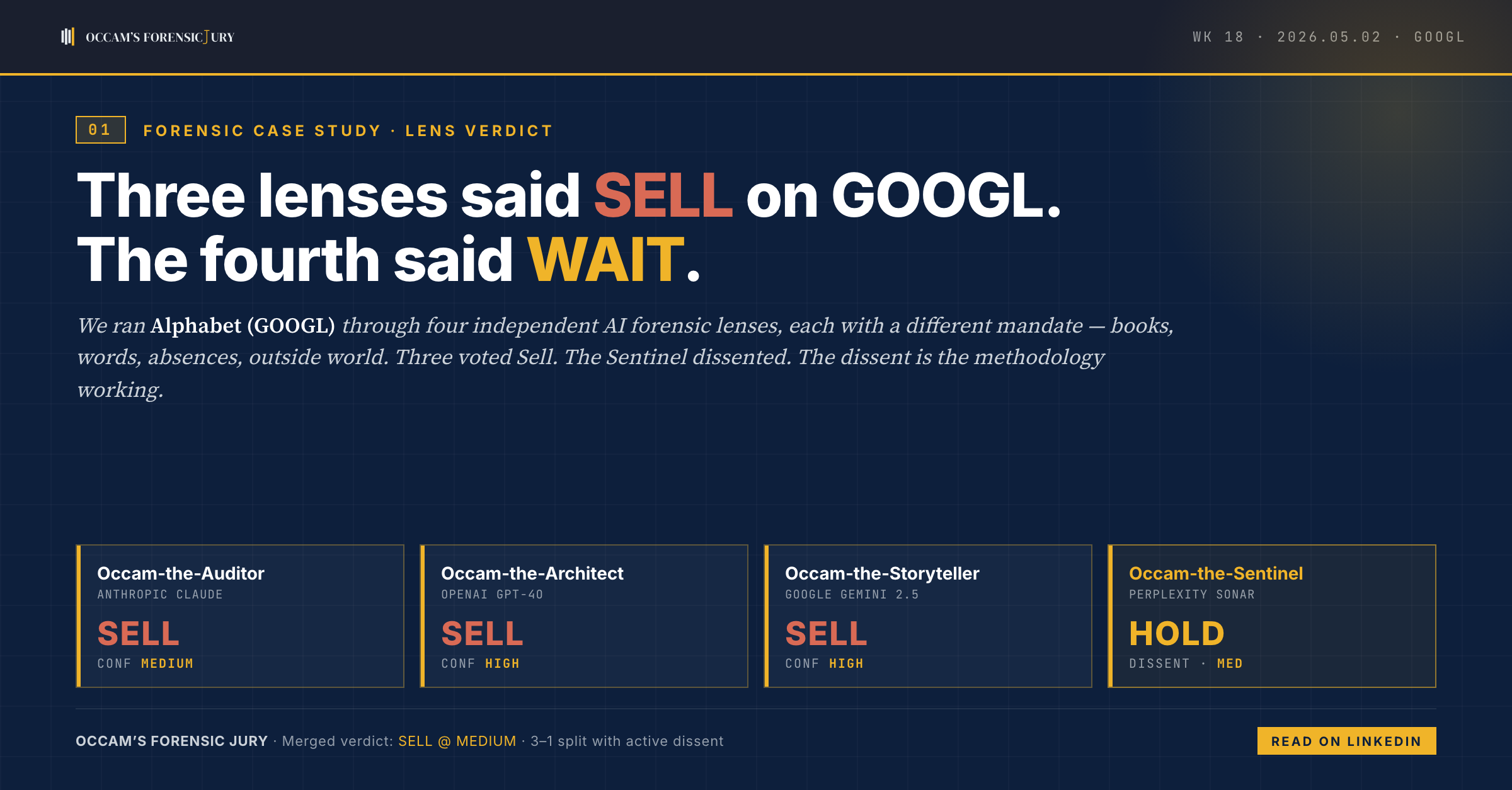
We ran Alphabet (GOOGL) through it this week. The result: three lenses voted Sell. The fourth pushed back hard. That dissent is the story.
The headline verdict: SELL with conflict
Three lenses Sell. One Hold. Trimmed from the HIGH confidence a clean 4-of-4 would have produced.
That trim is the methodology earning its keep. Single-model analysis can't disagree with itself. Ours just did.
Here's what each lens saw.
The Auditor reads the books
"FCF yield 1.57% — below the 10-year Treasury. The risk-free rate pays you more than Alphabet's cash flow at today's price."
Alphabet's books are exceptional. Operating cash flow margin of 40.9% at $403B in revenue scale is extraordinary. Net debt is negligible relative to equity. The Rule of 40 score is 56 — well above threshold. There is no quality problem here.
The price is the problem. Two independent DCF models — our internal model at $160 and a third-party crosscheck at $195 — both indicate the stock is trading 49–59% above intrinsic value. The free cash flow yield at the current $4.66T market cap is 1.57%. The 10-year Treasury yields more.
The Auditor's calibrated MEDIUM confidence comes from one honest question: $91.4B in annual capex (roughly 55% of operating cash flow) is being deployed into AI infrastructure. Whether that capex earns adequate returns is unknowable from current data. If it does, the picture changes. If it doesn't, the books are clear.
The Architect reads the words
"The narrative avoids confronting the overvaluation issue directly, maintaining a business-as-usual tone."
Our forensic linguist juror parses the language of management's own disclosures — the precise word choices, the hedges, the things stated only obliquely. What it found in GOOGL's filings: 60.8% of enterprise value is in the terminal value. That means most of what the market is paying for sits beyond the explicit growth period — pure assumption about what happens after year ten.
The disclosure language never defends those assumptions. The prose is confident, polished, business-as-usual — the rhetorical posture of a company whose books match its valuation. The math says the books don't match the valuation. The Architect noticed the gap between the two.
The Storyteller reads the absences
"The market is narrating a future the company isn't telling."
The Storyteller's specialty is what's not in the disclosure. What management used to discuss and quietly stopped discussing. Where you'd expect a number and find a hedge. Which competitive threats get one sentence when they should get a paragraph.
The cleanest finding: DCF-implied P/E of 14.7. Industry P/E of 163. The market is paying for an optionality that the company itself is not narrating. No detailed Cloud profitability roadmap. No specific monetization framework for "Other Bets" beyond high-level mentions. No competitive moat thesis on AI displacement risk.
The Sentinel pushed back
"The dossier predates the Q1 2026 earnings catalyst and the subsequent 15–20% analyst target lift."
This is where the methodology works. The Sentinel's job is to bring the outside world into the jury room — news, analyst moves, competitor actions, anything the dossier doesn't see because it post-dates the filing. On GOOGL, it brought back evidence the other three lenses couldn't access:
- Q1 2026 earnings landed April 29 with sales up 22% to $110B, Google Cloud up 63% to $20B, operating margins up 220 basis points
- Analyst price targets repriced upward 15–20% in the days after — Wells Fargo to $397, Simply Wall St to $305.66, consensus $402.34
- Zero downgrades; pure upside revisions
- The dossier's DCF assumes 11.16% growth in perpetuity. The post-Q1 repricing implicitly assumes 13–15%. If AI monetization sustains that, the margin of safety narrows from −58% to roughly ±5%
The Sentinel voted Hold at MEDIUM confidence. Its reasoning: the bear case rests on growth assumptions written before the catalyst that may have already invalidated them.
Three lenses said sell on the books, the words, the silences. The fourth said wait, the world moved while you weren't looking.
What this means for the investor
The merged verdict came out SELL with MEDIUM confidence, conflict flagged. The dissent is doing real work.
For an investor looking at GOOGL right now — or for an advisor whose client just asked "what about Google?" — this is a more useful answer than 88% Buy from sell-side or a clean 4-of-4 Sell from a single AI model. It says: the price is hard to defend at conservative growth assumptions, AND the post-Q1 earnings catalyst could resolve that gap by Q3 if AI monetization sustains. Two scenarios with explicit triggers, not one verdict masquerading as certainty.
The methodology's job isn't to produce confident calls. It's to surface where the lenses disagree and why — so you can make the judgment call with full information, not the illusion of consensus.
The full teardown
We've published the complete 2-page forensic teardown — verdict, cash flow chart, all four juror takes including the Sentinel's dissent, sector scorecard, lens findings, kill criteria, and methodology — at the link below.
→ Read the full GOOGL forensic teardown
→ Long-form research write-up: how the four lenses disagreed
→ How the Forensic Jury works